Newsletter Subscribe
Enter your email address below and subscribe to our newsletter

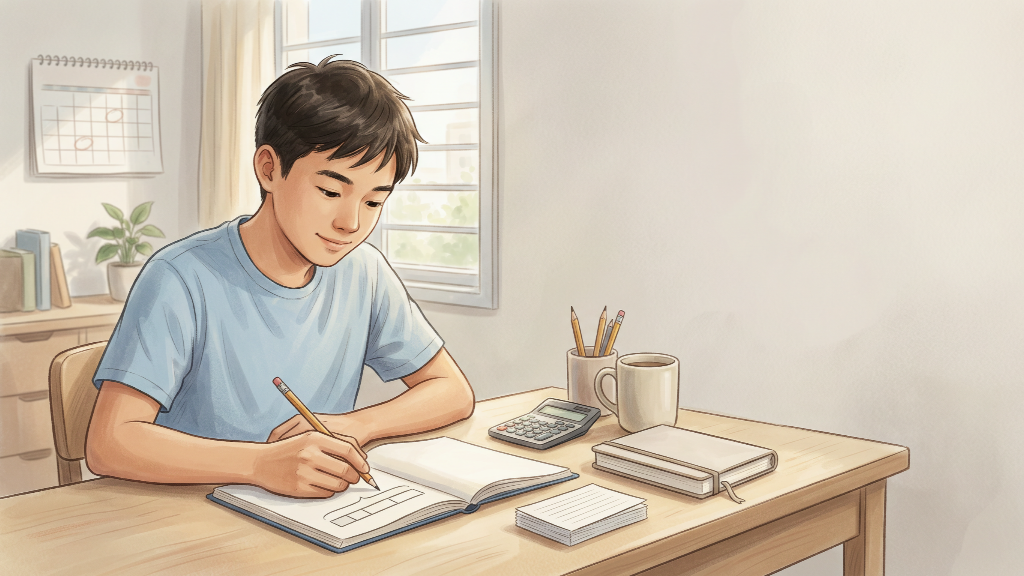
You sit down to study math. Two hours later you’ve reread the chapter twice, highlighted half of it in yellow, and you still can’t solve the first practice question. Sound familiar?
That doesn’t mean you’re bad at math. Usually it means the method is wrong, not you. A lot of habits that feel productive turn out to do surprisingly little.
Singapore has a strong record in international math studies, and part of the reason is how the subject is taught there: understand the idea, picture it, then practise it properly. You don’t need a Singapore classroom to borrow that. Here are six methods you can start using today, whether you’re preparing for school exams, a job test, or just trying to stop dreading math.
Formulas are tempting. Copy them onto a card, learn them by heart, and hope the exam asks for exactly what you practised. That works right up until a question is worded differently.
Try asking why before you ask how. Why does the area of a triangle have a half in it? Why does flipping a fraction let you divide? If you can explain the reason in a sentence or two, you can rebuild the formula even when your memory goes blank. And in an exam, that happens to everyone at some point.
In Singapore classrooms, students are taught to move from real objects, to pictures, to symbols. It’s called the Concrete, Pictorial, Abstract approach, and the TIMSS description of Singapore’s curriculum names it as central to teaching at primary and lower secondary level.
You can use the picture step at any age. Take this one: Mei has twice as much money as Raj, and together they have $90. How much does Mei have?
Draw one bar for Raj and two equal bars for Mei. That’s three equal bars, adding up to $90. So one bar is $30, which makes Mei’s share $60.
Notice what the drawing did. It’s just the equation 3x = 90 in a friendlier outfit. Once the picture feels natural, algebra stops feeling like a foreign language.
Here’s the uncomfortable bit. Rereading your notes feels great because everything looks familiar. But familiar isn’t the same as learned.
A well-known review of study techniques, summarised by the Association for Psychological Science, gave its top rating to practice testing and to spacing out study sessions. Rereading and highlighting, the two things most students do, landed near the bottom.
So close the book. Try a few questions from memory, check your answers, and note what you missed. It’ll feel harder and a bit messier than rereading. That’s usually a sign it’s working.
Three hours on Sunday is better than nothing, but three 40-minute sessions across the week usually works better. Your brain needs a little forgetting in between, so that remembering takes some effort.
A simple pattern: learn a topic, revisit it the next day, again a few days later, and once more the following week. Put it in your calendar if you have to. Cramming the night before might get you through a quiz, but a lot of it will be gone by Friday.
Every wrong answer is information, and most students throw it away. Grab a cheap notebook. For each mistake, write down three things: the question, what went wrong, and the fix.
After a few weeks, patterns jump out. Maybe you keep dropping negative signs. Maybe you read the question too fast. Maybe it’s the same fractions step every single time. Once you can name your usual mistakes, you can start watching for them.
Try teaching the topic to someone. A friend, a sibling, or the wall if nobody’s around. Say each step and why it works. The moment you stumble is the moment you’ve found the gap.
This is called self-explanation, and it’s one of the techniques covered in that same research review. It also happens to be free.
Study methods help a lot, but sometimes you want a person to point out what you can’t see yourself. Families who search for the best Math tuition in Singapore are usually after one thing: a teacher who explains why a method works, not just which steps to copy.
That’s what we aim for at Jimmy Maths. We offer recorded video courses you can work through at your own pace, live Zoom lessons, and help with homework questions between sessions. Wherever you’re studying, look for a course or teacher that does the same.
You don’t have to change everything at once. Pick one method, maybe the error log or a short self-test, and try it for a week. Then notice what happens to the questions that used to trip you up.
Math tends to reward students who understand, practise and review, not the ones who simply study the longest. Do those three things a little at a time, and you might be surprised how far you get.