Newsletter Subscribe
Enter your email address below and subscribe to our newsletter

 Byadmin
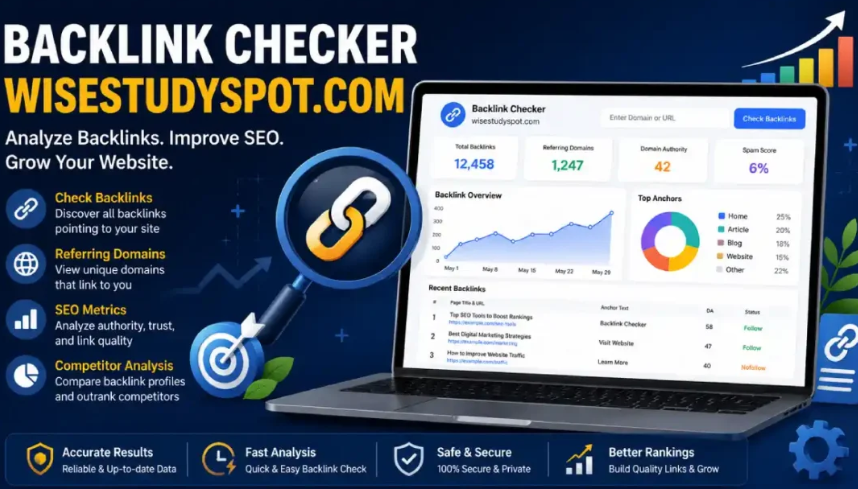
Backlink Checker Wisestudyspot. Com – Complete Backlink Analysis Guide is a search phrase that may be used by people looking for information about backlink analysis, SEO tools, domain authority, referring domains, anchor text, and link-building strategies.
Backlinks are links from one website to another. Search engines can use them as one of many signals when evaluating the relevance, authority, and reputation of webpages. However, not all backlinks are equally valuable. A small number of relevant, trustworthy links can be more useful than a large number of low-quality or manipulative links.
This guide explains how backlink checking works, what metrics matter, how to review competitors, how to spot risky links, and how to build a healthier backlink profile over time.
A backlink checker is a tool that identifies external websites linking to a particular domain or webpage.
A typical backlink report may show:
These reports help website owners understand who is linking to them and whether their backlink profile looks natural.
Backlink data can help answer questions such as:
This makes backlink analysis useful for SEO audits, content planning, competitor research, and digital PR.
The keyword Backlink Checker Wisestudyspot. Com appears to combine interest in backlink-checking tools with the Wisestudyspot domain.
A search phrase alone does not confirm that a specific backlink tool exists on that website. Users should verify the current website directly before assuming the availability of any particular feature or service.
If the goal is backlink analysis, the important thing is understanding what a good backlink checker should provide and how to interpret the data correctly.
These two metrics are related but different.
Backlinks count individual links pointing to your site.
One website may link to you dozens of times.
Referring domains count the number of unique websites linking to you.
For example:
In many cases, a diverse set of high-quality referring domains is more meaningful than a large number of repeated links from a single site.
A valuable backlink usually has several positive characteristics.
A link from a website related to your subject is often more useful than a completely unrelated link.
For example, a technology blog linking to a software tutorial is contextually relevant.
Links placed naturally within useful content are generally stronger than links inserted into spammy directories or mass-generated pages.
Links from established, reputable websites are usually more valuable than links from low-quality or suspicious domains.
Anchor text should fit naturally within the sentence.
Over-optimized exact-match anchors repeated across many websites can look manipulative.
A backlink is more valuable when it can actually send relevant visitors to your website.
SEO value should not be the only consideration.
Anchor text is the clickable text used in a hyperlink.
Common types include:
Wisestudyspotwisestudyspot.combacklink analysis guideclick herebacklink checkerA natural backlink profile usually contains a mixture of anchor types.
If hundreds of links use the exact same commercial keyword, the pattern may appear unnatural.
Instead of trying to control every anchor, focus on earning links through useful content and genuine mentions.
Backlink tools often classify links based on their HTML attributes.
“Dofollow” is an informal SEO term for standard links without restrictive attributes.
These links may pass ranking signals.
Links marked with rel="nofollow" tell search engines not to treat the link as a normal endorsement in the same way.
Other attributes include:
rel="sponsored" for paid or sponsored linksrel="ugc" for user-generated contentA natural backlink profile can include a mixture of link types.
A structured audit helps you understand the health of your backlink profile.
Use a reputable SEO tool to collect backlink information.
Common commercial tools include:
Google Search Console also provides backlink information for verified site owners, though its reporting differs from commercial databases.
Look for:
The goal is to understand the overall quality and diversity of your links.
Review whether anchor text looks natural.
A profile dominated by one exact-match keyword deserves closer attention.
New backlinks can reveal successful content or PR activity.
Lost links can indicate:
Important lost links may be worth reclaiming.
Potential warning signs include:
Not every strange-looking backlink is harmful, so avoid overreacting.
“Toxic backlink” is a common SEO phrase, but it is not an official universal classification.
Some SEO tools label links as toxic based on risk signals.
These signals may include:
Search engines are generally good at ignoring many low-quality links automatically.
Manual removal or disavowal should be approached carefully, especially because removing legitimate links by mistake can harm performance.
Google recommends the disavow tool only in specific situations, particularly when a site has a significant number of artificial, spammy, or low-quality links and there is concern about a manual action.
One of the most useful applications of backlink checking is competitor research.
Look for websites that link to competitors but not to you.
These may include:
Competitors may earn links through:
These patterns can inspire better content ideas.
A link gap exists when several competitors receive links from the same domain but your site does not.
This can indicate a realistic outreach opportunity.
The safest long-term strategy is earning links through useful assets and genuine relationships.
Examples include:
People are more likely to link to content that provides unique value.
Journalists and bloggers often need expert commentary, data, or useful resources.
Providing genuinely helpful insights can lead to editorial mentions and backlinks.
Some websites maintain resource pages linking to useful tools and guides.
If your content genuinely belongs on such a page, respectful outreach can be effective.
This strategy involves finding broken links on relevant websites and suggesting a useful replacement.
It works best when your replacement truly matches the original resource.
Sometimes websites mention a brand without linking to it.
A polite request may convert that mention into a backlink.
A backlink checker may provide many metrics, but some are more useful than others.
| Metric | What It Shows |
|---|---|
| Total Backlinks | Number of external links |
| Referring Domains | Unique websites linking to you |
| New Links | Recently discovered backlinks |
| Lost Links | Links that disappeared |
| Anchor Text | Clickable text used in links |
| Link Type | Follow, nofollow, sponsored, or UGC |
| Top Linked Pages | Pages attracting the most links |
| Domain Metrics | Third-party estimates of site strength |
Third-party authority scores are helpful for comparison, but they are not Google ranking metrics.
Cheap link packages often come from low-quality networks and can create unnecessary risk.
Ten strong links can be more valuable than thousands of irrelevant ones.
A backlink from an unrelated site may provide little value even if the domain appears strong.
Natural backlink profiles contain varied anchor text.
A link that sends real, relevant visitors may be more valuable than one with a high third-party score but no audience overlap.
If users search Backlink Checker Wisestudyspot. Com while researching SEO, the most practical approach is to use backlink analysis as part of a broader strategy.
Backlinks should be evaluated alongside:
No backlink checker can replace a complete SEO audit.
The ideal frequency depends on the size and activity of the website.
Monthly checks may be sufficient.
Weekly or biweekly reviews can help monitor new campaigns and lost links.
More frequent monitoring may be useful, especially during major PR, content, or link-building campaigns.
It is a search phrase combining backlink-analysis interest with the Wisestudyspot domain. Users should verify the current website directly to confirm whether any specific backlink tool is available there.
It identifies websites and pages linking to a domain or webpage and may provide information about anchors, referring domains, link attributes, and link history.
No. Relevance, trust, diversity, and editorial quality matter more than raw quantity.
A referring domain is a unique website that links to your site.
Anchor text is the clickable text used in a hyperlink.
No. They can still send traffic, build awareness, and contribute to a natural backlink profile.
No. Many low-quality links may simply be ignored by search engines. Take action only when there is a clear reason and understand the risks before using removal or disavow tools.
Yes. It can help identify link opportunities, understand competitors, recover lost links, and evaluate overall link quality.
Create useful original resources, build genuine industry relationships, contribute expert insights, and promote content to relevant audiences.
Backlink Checker Wisestudyspot. Com – Complete Backlink Analysis Guide represents the broader topic of understanding how websites earn, lose, and manage external links.
Backlink analysis is most useful when it focuses on quality rather than quantity. Relevant referring domains, natural anchor text, editorial placement, and real traffic potential are more meaningful than simply collecting thousands of links.
A strong SEO strategy combines backlink monitoring with useful content, technical performance, internal linking, and good user experience. By reviewing backlink data regularly and avoiding manipulative link schemes, website owners can build a healthier and more sustainable search presence.